US Dollars


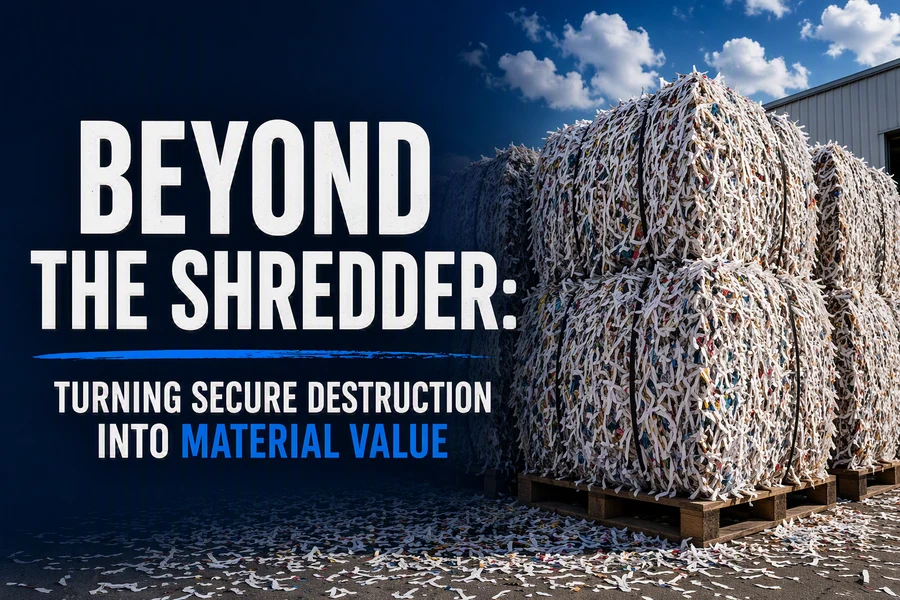
How secure document destruction can protect data, support recycling, and create more value from every paper stream.
|
46M tons paper recovered for recycling in 2024 |
60-64% estimated U.S. paper recycling rate in 2024 |
7,000 gallons water saved by recycling one ton of paper |
3.3 yd³ landfill space saved by recycling one ton of paper |
Secure destruction is only half of the story.
For most organizations, document shredding feels like the finish line.
Confidential files are destroyed. Compliance requirements are met. Sensitive information is protected from unauthorized access. The risk is reduced, the job is done, and the data is out of sight.
But the story should not end there.
Once the information is gone, the material still has value. Shredded paper should move into a recycling stream where recovered fibers are prepared for a second life in products such as corrugated boxes, tissue products, paper towels, protective packaging, printed materials, and cellulose-based insulation.
The bigger story is not just what gets destroyed. It is what can be recovered next.
Compliance is More Than Particle Size.
Customers often focus on shred size because it is the most visible part of destruction. But secure document destruction is not only about what happens inside the cutting chamber.
A defensible secure destruction process includes secure collection, controlled handling, documented chain of custody, tracked transport, facility controls, employee training, verified destruction, and final disposition. In this context, final disposition should mean moving material to trusted recyclers, not sending recoverable paper to landfill. Every handoff matters.
If any part of that process is weak, the overall security promise becomes weaker too. A perfectly shredded document means very little if the processes around it are not equally secure.
Paper Is Too Valuable to Treat Like Waste.
Paper remains one of the most widely recycled materials on the planet. In 2024, approximately 46 million tons of paper were recovered for recycling in the United States, equal to roughly 125,000 tons per day.
Recovered paper is not simply a waste by-product. It is valuable feedstock that can be transformed into containerboard, tissue products, packaging materials, newspapers, and other paper-based products.
For shredding operators, recyclers, and secure destruction providers, that means the paper leaving the shredder continues to have economic value well beyond the destruction process.
Not All Shredded Paper Is Created Equal.
The value of recycled paper depends heavily on the quality of the fiber being recovered. Compared with many mixed material streams, documents are relatively clean feedstock, which gives recovered paper a stronger starting point for recycling. Paper fibers can be reused multiple times when they maintain enough length, strength, and flexibility to support new products.
This is why effective shredding is not simply about making paper disappear. There is a balance between security, throughput, operating efficiency, dust control, fire safety, and material recovery. Shredding paper too finely can reduce fiber quality. Processing it inefficiently can increase handling costs, slow production, create unnecessary dust, or reduce downstream value.
The best destruction process protects information while preserving the value of what remains.
The Environmental Impact Is Significant.
Recycling paper delivers measurable environmental benefits. Recycling one ton of paper can save enough energy to power the average American home for six months, conserve approximately 7,000 gallons of water, save 3.3 cubic yards of landfill space, and reduce greenhouse gas emissions.
For organizations focused on sustainability, waste diversion, or environmental reporting, secure destruction programs can contribute to broader goals while still prioritizing information protection.
From Documents to New Products.
Once documents have been securely destroyed, the recovered paper begins a new journey. It may be collected, baled, compacted, transported, pulped, blended, and remanufactured into something entirely different.
What started as confidential records may become the box that ships an online order, paper towel used in a facility, protective packaging for transported goods, or insulation inside a building.
That transformation is a practical example of the circular economy, where valuable resources are recovered and reintroduced into manufacturing.
The Real Value of Secure Destruction.
Organizations often view document destruction as necessary but routine. In reality, it sits at the intersection of information security, compliance, operational efficiency, sustainability, and material recovery.
For operators, the opportunity is to think beyond the shredder itself. Paper has market value, and secure destruction can create revenue at more than one point in the process. Customers pay for the shredding service, and the recovered shredded paper can also generate revenue when it is prepared and sold into the recycling stream.
A well-designed system supports the full journey, from protecting sensitive information to preparing recovered fiber for its next use.
Ready to explore what is possible?
|
Organizations that understand how to protect data, optimize processing, and create efficiency throughout the material lifecycle are positioned to get more from every ton they handle. Contact Shred-Tech to discuss a mobile or processing solution tailored to your operation. |